|
Off the Grid
Going off the Grid is a choice of survivalists or remote
homesteaders, but what if it were not a choice? Electricity can
be generated from a Wind or Water mill, or Solar Panels, or even
charging a battery by churning a bike. The Troubled Times
nonprofit explored these issues in depth a decade ago, and the
wisdom they hold then still apply.
The grid may be destroyed and petrol products quickly consumed
by generators and vehicles, and then these too will be idle.
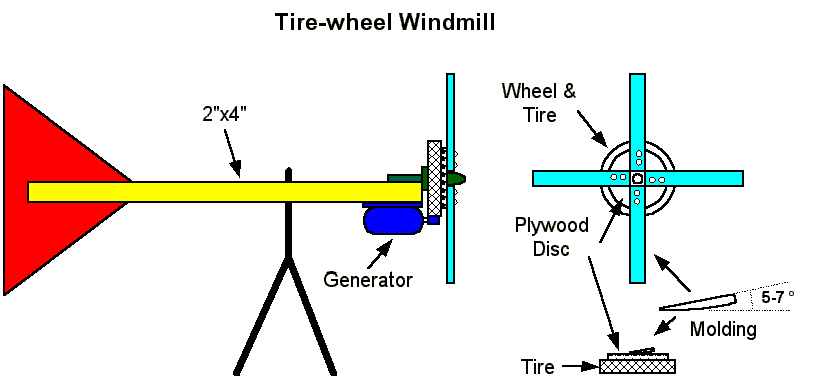
What to do for electricity? Windmills can be constructed
from trash such as from lawn
mower parts.or a ground based Nebraska
windmill.
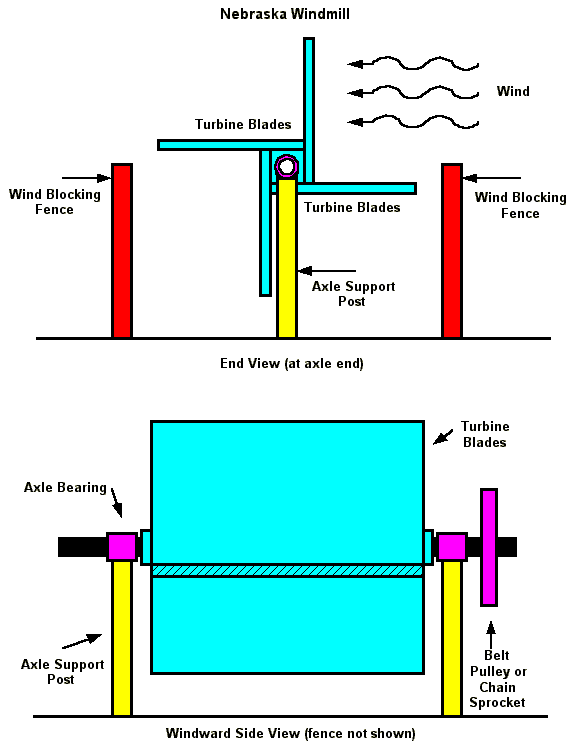
A ground based Nebraska
windmill is easy to maintain as one does not have to climb
a pole. The Nebraska windmill is set to catch the prevailing
winds and can be easily shuttered for protection during storms.
William Kamkwamba. a 14 year old boy in Africa, demonstrated
that he could build a windmill from scrap to irrigate the
gardens in his village. If this 14 year old boy can build a
windmill from junk parts, so can you.

- Malawi Windmill Boy with Big Fans
October 1, 2009
http://news.bbc.co.uk/2/hi/africa/8257153.stm
- The teenager had a dream of
bringing electricity and running water to his village.
When not helping his family farm maize, he plugged away at
his prototype, working by the light of a paraffin lamp in
the evenings. Neighbours were further perplexed at the
youngster spending so much time scouring rubbish. Mr
Kamkwamba knocked together a turbine from spare bicycle
parts, a tractor fan blade and an old shock absorber, and
fashioned blades from plastic pipes, flattened by being
held over a fire. Out went the paraffin lanterns and in
came light bulbs and a circuit breaker, made from nails
and magnets off an old stereo speaker, and a light switch
cobbled together from bicycle spokes and flip-flop
rubber. Then he built a new windmill, dubbed the
Green Machine, which turned a water pump to irrigate his
family's field.
Water wheels can be large or small. One can even be constructed to
twirl during a rain storm if set within a drain pipe. Large
hydroelectric generators are set within dams. Where the slope of a
hill is significant, a High
Head setup can take advantage of the automatic force of the
water. Ram
Pumps can convert the force of water flowing downstream to
push water uphill.
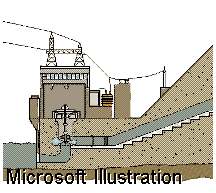
If you live in a hilly area where there are small streams, you can
develop a very adequate power system with very little flow. This
is called a High Head System and it involves as little
as a 50 foot drop with only a one gallon per second flow to yield
an average power of a steady 300 watts. This is enough power to
drive your lights and other small appliances. With a battery
support, or flywheel or spring support, you'll be able to develop
a really adequate power system for almost no money and at very
little expense. You want to use the batteries to store
power during the period of little use from 10 PM to 6 AM. You can
vary the output by the diameter of the pipe, the length of the
pipe, and the amount of water you can get into the pipe. It relies
on a large vertical drop rather than a large volume of water. Thus
a power plant near a small stream waterfall, or a contrived water
fall.
Hydraulic Ram Pumps are a class of water pumps that use the
inertia of water to pump water to say 10 times the height that
water falls. No power source needed. For example let us say we
capture a water head pressure of 140 ft into an automatic running
Hydraulic ram pump. This might pump 1/12 the volume that enters
the pump up the side of a hill to about 1400 ft to a holding tank
above where your site is. This would run 24 hrs/day for free. Any
excess water you don't use can be converted to electricity. With
prevalent rain after the pole shift one could divert water to your
holding tank from further up the hill. Once the rains stop or slow
down, implement the Hydraulic Ram Pump. The process can be
implemented at relatively low cost. The items don't take up much
space. They are simple construction and easy to repair. The
concept of a hydraulic water mill can
be demonstrated.
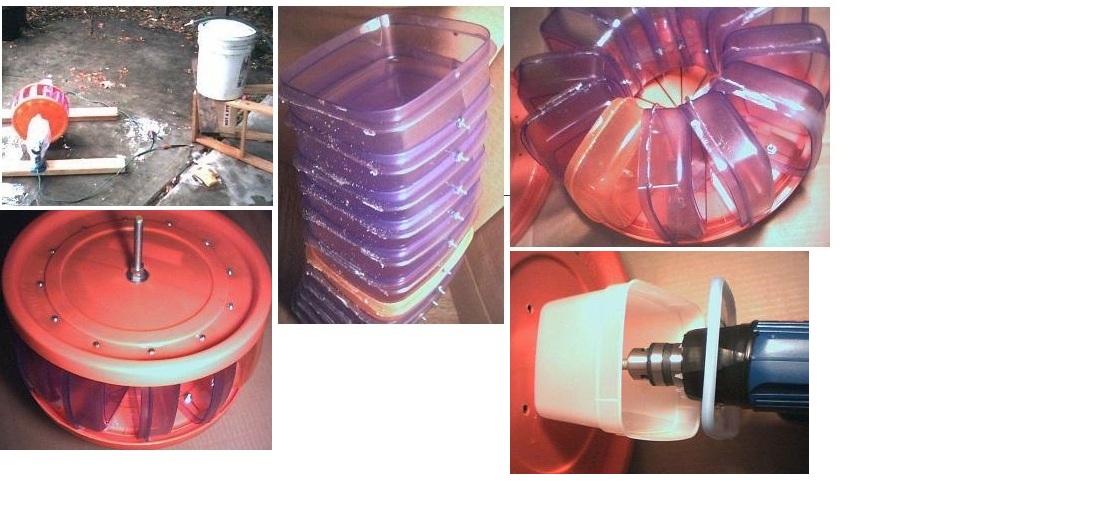
- Water wheel construction: One soon
will get tired of hand cranking and will want to find a
better way. In the near continuous raining condition as is
predicted after a pole shift, water flow in uneven land
conditions creates some interesting opportunities. Even
small areas collecting water will create a significant
amount of run off water flow. All one need do is position
a portable constructed paddle wheel where there is as
small as 1 to 1.5 foot water flow drop at a rate of at
least about 20 gallons/min and use two cordless drills
wired in series as generators. 12 small plastic containers
and several 5 gallon bucket lids can be used to create a
water wheel. Stack one plastic container on top and nested
in the lower one. Drill in a hole in the middle of one of
the longer sides. Use a #8-32 by .5" long machine screw
and nut to fasten them together.
- The containers are positioned so
the overlap is just barely enough to bolt them together.
Use one container of a different color to aid counting
revolutions in a given stop watch timed run to determine
RPM. One can measure the time it takes for say 20
revolutions to determine RPM. I used 12 containers (Good
Buy Mini Container distributed by PTS long Beach Ca) and
two 5 gallon bucket lids. These were purchased at a $.99
store for 3/$.99. Once all 12 are bolted together on the
back side then unbolt the bottom container and place it on
top, drilling and bolting it in. Now take a disk sander
and sand off the lips on the sides that will be bolted to
the bucket lid. This makes it so one has a fl
- Mark and drill holes in one lid
then use this lid as a guide to drill the holes in the
other lid. Add a ring of "silicon-I" sealer and centered
the now circular ring of plastic containers and drill-bolt
the buckets to the lid. Cut a 4.75" long .5" diameter
aluminum or copper tubing put 3/8" washers at each end and
glue with silicone sealer. I used a threaded rod and a
couple of nuts to hold it until the silicone sealer set
up. Use this pipe as a spacer between the lids in the
center when assembling the last side. One water wheel
weight is about 3 lbs two is about 5 lbs. Caution: the
3/8"shaft will bend if nuts are tighten against a pipe
that has a non-square end. Use a pipe cutter and get a
square end.
- The threaded shaft sticks out
about 4.5" on each side. Use in this order a garden hose
rubber washer, finder washer, normal washer, lock washer
and two nuts locked together to hold the shaft from
slipping on the 5 gallon plastic lid. To keep the water
form over time getting to and rusting the drill chuck
(spray with oil at assembly time) of the drill take a
small square shaped plastic container and drill a hole in
the bottom and pie shape cut the lid. Bend some (3 in my
case) of the pies up and all the rest down. Drill a small
drain hole at the lowest corner so that if any water leaks
in, it will drain out. The pie tabs will be taped to the
drill to hold it in place.
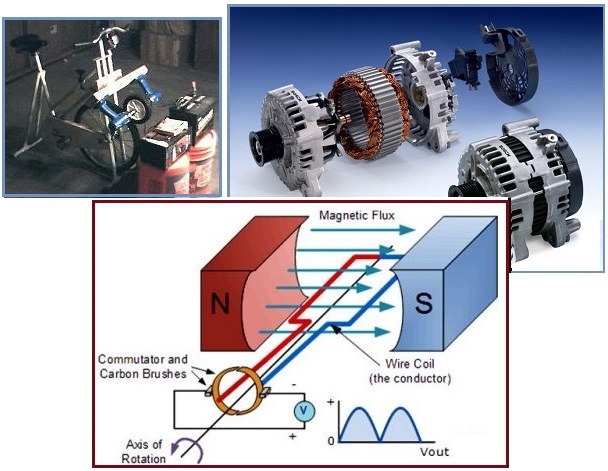
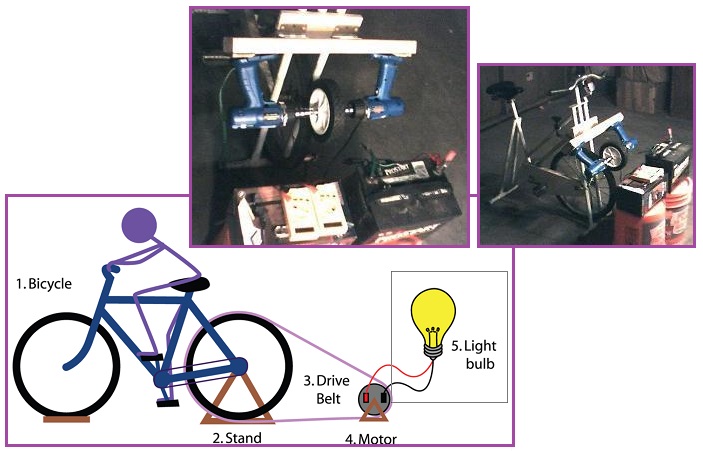
A bike generator can likewise be made from a discarded
bike. All one needs is an alternator, which can be found in
any car and many appliances such as lawn mowers.
The Troubled
Times nonprofit explored battery maintenance and this
wisdom is still pertinent today.
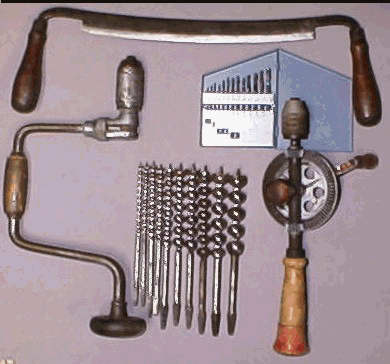
To prepare for the time when rebuilding from junk might be
necessary, gather some of these inexpensive items available now at
stores. Collect clean rain water using gutter pieces. Tack screen
in place to keep the mosquitoes out. Gather hand
tools, which can be purchased off the Internet ahead of time
and secure some camping equipment too.
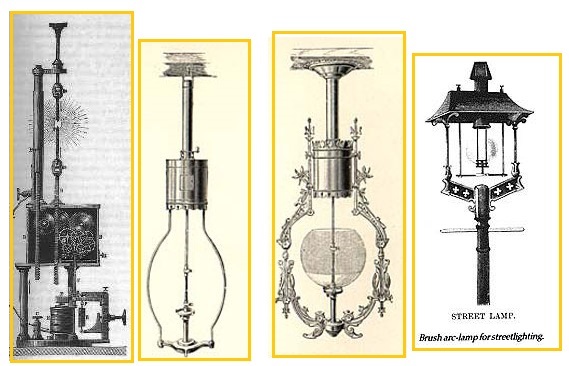
Another piece of junk that might prove to be immensely important
when all your light bulbs burn out. Yes LED bulbs last longer, but
eventually you might be producing electricity but unable to have
light. The answer is Carbon
Arc lamps, used in the past to turn the streets of London as
bright as day. A Carbon Arc is created when direct current is
forced to jump from one piece of carbon to another. Pencil leds
are Carbon/Graphite, and work as the Carbon points. Discarded
battery cores are also Carbon, and are found in the trash.
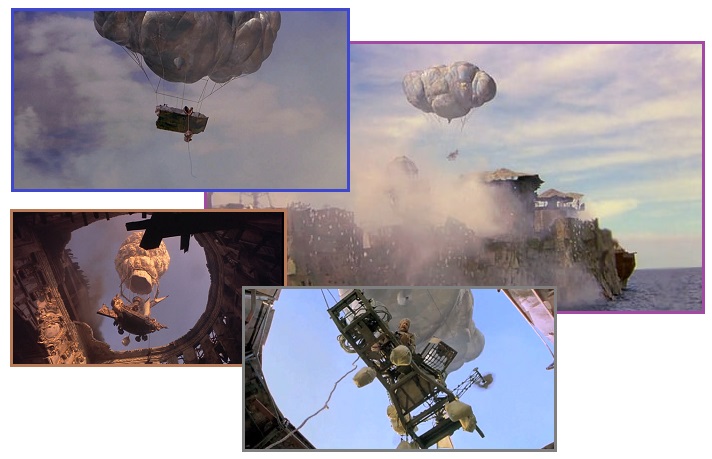
Accomplished junkmen are sometimes depicted in the movies, for
instance in the movie Waterworld, where the group seeking “dry
land” takes off in an air balloon composed, no doubt, from shark
and whale skins stitched together or from whatever has been
dredged up from the bottom of the ocean. Houseboat living is
featured, with container gardening and fishing and distillation of
drinking water. Houseboat communities are also featured, surviving
on methane gas. All from junk.

|